Soundscape Campus 2017
How is scientific research informed by sound? A report on the interdisciplinary discussions, field practices, and artistic productions that evolved over the course of the Soundscape Campus.
Aim
What are the implications of taking listening as an analytical mode as valid as the observations of charts, statistics and spectrograms? What if we reflect on ecology, society and its historical transformations through the ear? How does our experience change when we consciously frame sound as a way of relating to space and place, of composing our understanding of the real? How does careful and deep listening and the engagement with sound as matter in artistic practice help us to think critically and affectively about peoples and environments?
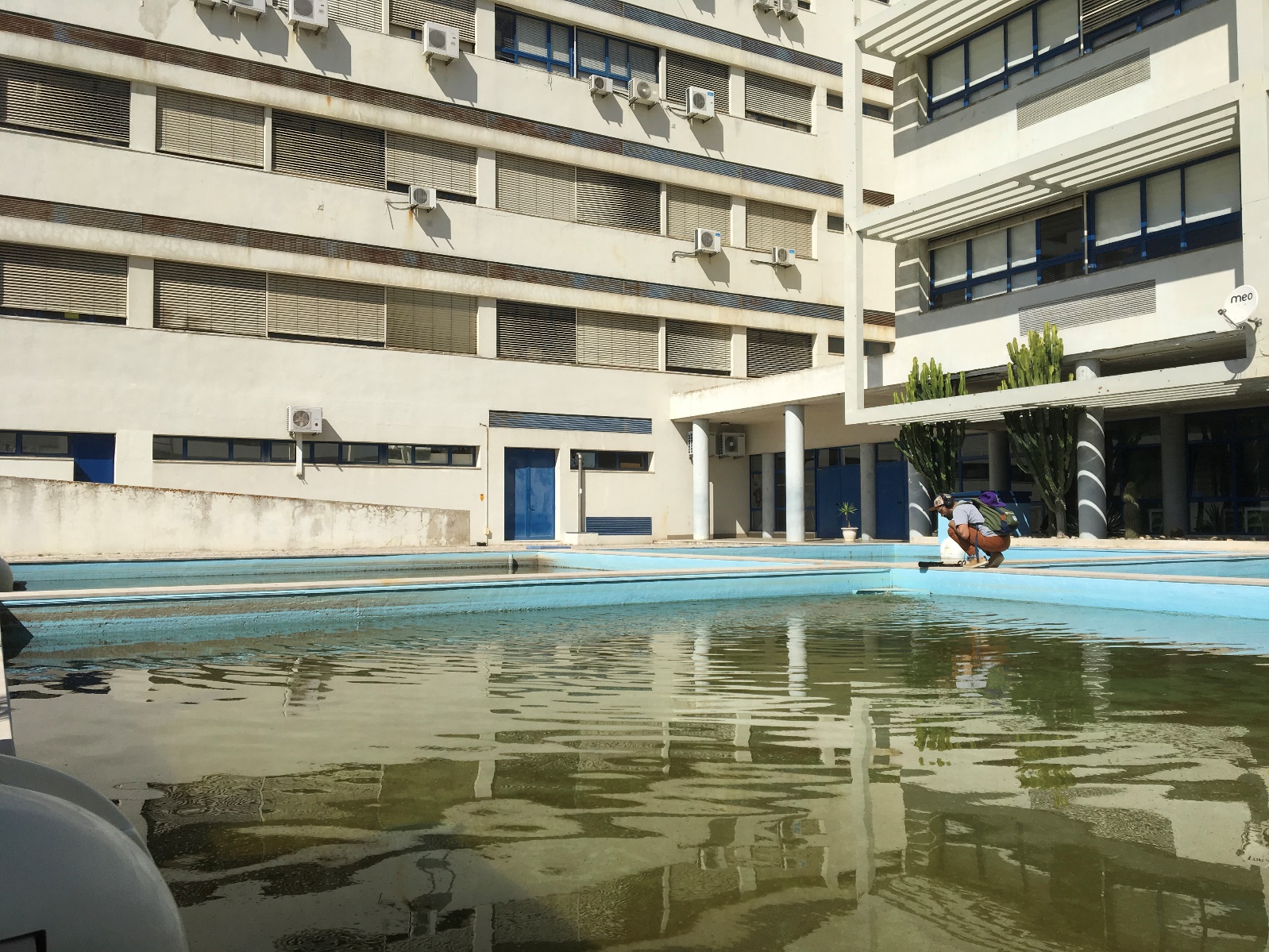
These were some of the questions posed to participants of the 1st FCT Soundscape Campus (4-7 October 2017) that took place at the Caparica Campus of the Faculty of Sciences and Technology (FCT) of NOVA University of Lisbon.
This event was a collaboration between the Interuniversity Centre for the History of Science and Technology (CIUHCT) and the Collected Sound Fragments for an imaginary landscape workshops (CSF) led by sound artists Nils Meisel and Pedro André.
The main purpose of the Soundscape Campus was to promote sonic culture among students and faculty staff. We sought to remember that sound is a vital part of our daily experience, as well as an element of scientific research (both as object and as epistemic tool), and to go beyond the conventional forms in which it is usually debated, i.e. either as music or noise pollution.
Activities
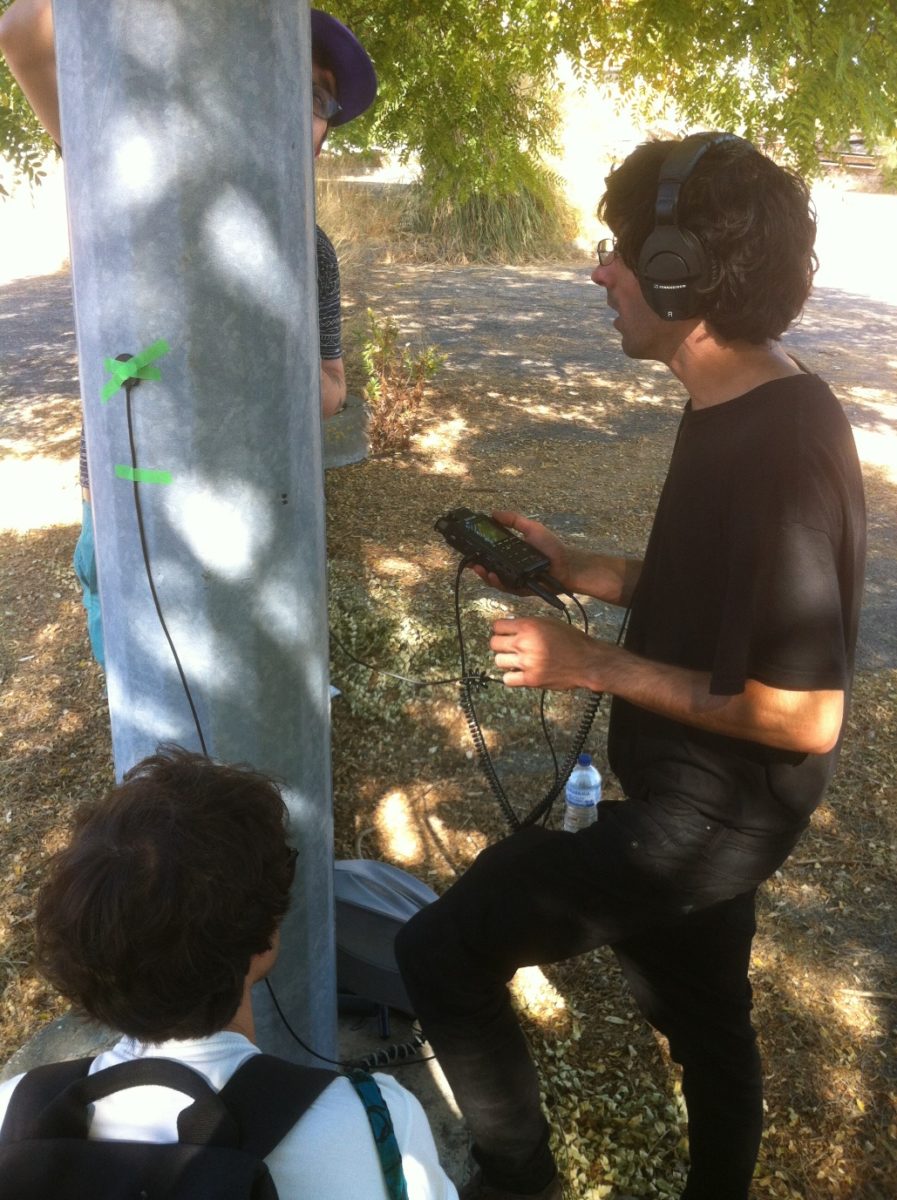
The Soundscape Campus entailed a set of activities that bridged theoretical discussions with practical, hands and ears-on approaches to the sensing of acoustic spaces and artistic creation. Participants took part in a colloquium, soundwalks and field recordings. Together we enacted sonic ambulations and explorations of the campus outdoors and indoors, collecting ambiences and sound fragments. At all times participants were attuned to the critical reflexion on sound as a vehicle for the discussion on the cenes (Anthropocene and derivatives), nature-culture dichotomy, and societal challenges. As many of the sounds could not be heard by the naked ear—e.g. they had to be amplified by very sensitive microphones— technology as an expanded sensorial apparatus became an important topic of debate.
Sound materials gathered during the campus were used as raw material for the collaborative creation of two soundscape compositions and the FCT Sound Map.
Concerning the soundscape compositions, two groups of participants had to negotiate what they wanted to be heard, how it would unfold and how it could convey an idea of their sonic ambulation during the workshop. No special expertise was needed, as participants were encouraged to openly and democratically engage with the process of artistic creation and assisted by two experienced sound artists (Nils Meisel and Pedro André). These transformative actions, in which each participant engages with sound as matter capable of being altered and recombined into a creative and interpretative work, reinforced the sensorial and affective engagement that took place during the soundwalks. Each participant and each group showed different aesthetic interpretations of the sound events that were captured with the recording equipment and that still lingered on as aural memories. These sound works can be listened to here.
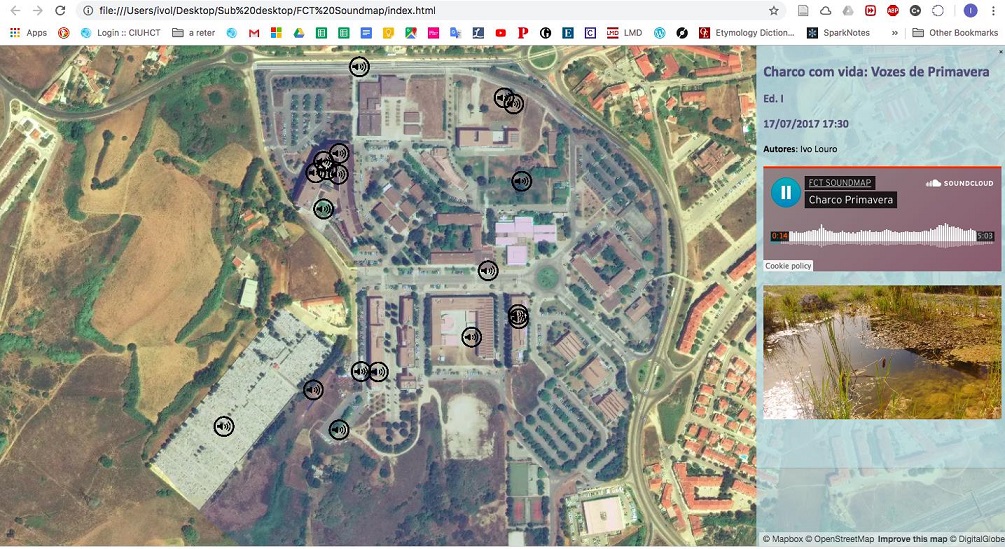
The FCT Sound Map is an archive of the characteristic sound objects and soundscapes of the faculty campus. The purpose is to create a georeferenced interactive sonic archive that allows for the monitoring of acoustics changes throughout time and how these reflect environmental and societal changes at the Caparica Campus. It will be available soon on the Faculty’s webpage.
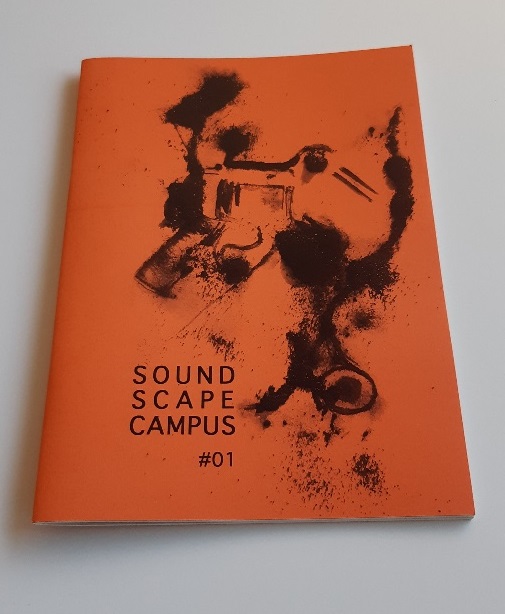
The activities and results of the Soundscape Campus were showcased in the Soundscape Campus Exhibition that took place between 04-24 May, 2018, at the FCT Library. During the final day of the exhibition, there was a new colloquium on birdsong and the mass extinction of avian species. A sonic sculpture/performance by the West Coast artistic collective was a literal and metaphorical centrepiece that launched the discussion on the current and historical dynamics that has led to a decline of bird life in Europe and elsewhere.
Team
Ivo Louro, CIUHCT
Davide Scarso, CIUHCT
Hugo Almeida, CIUHCT
André Pereira, CIUHCT
Maria Paula Diogo, CIUHCT
Jaume Vallentines-Alvaréz, CIUHCT
Pedro André, CSF — Collected Sound Fragments for an Imaginary Landscape
Nils Meisel, CSF — Collected Sound Fragments for an Imaginary Landscape
Francisco Pinheiro — West Coast
Paulo Morais — West Caost